Planning for Uncertain Futures
Dynamic Adaptive Policy Pathways for
Pāpāmoa Beach, Tauranga
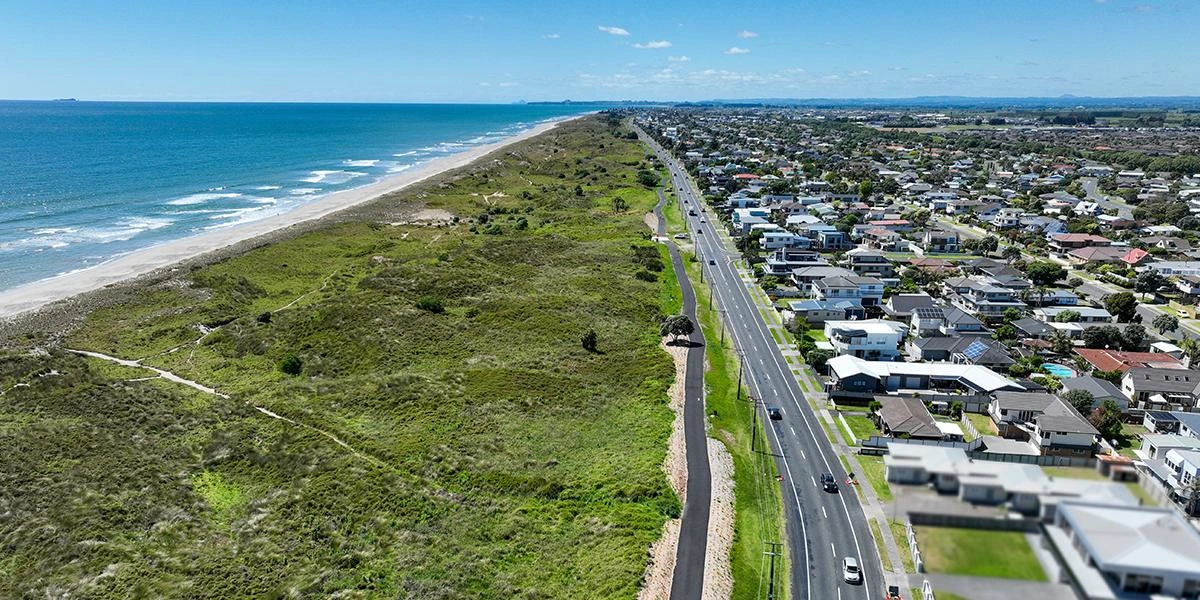
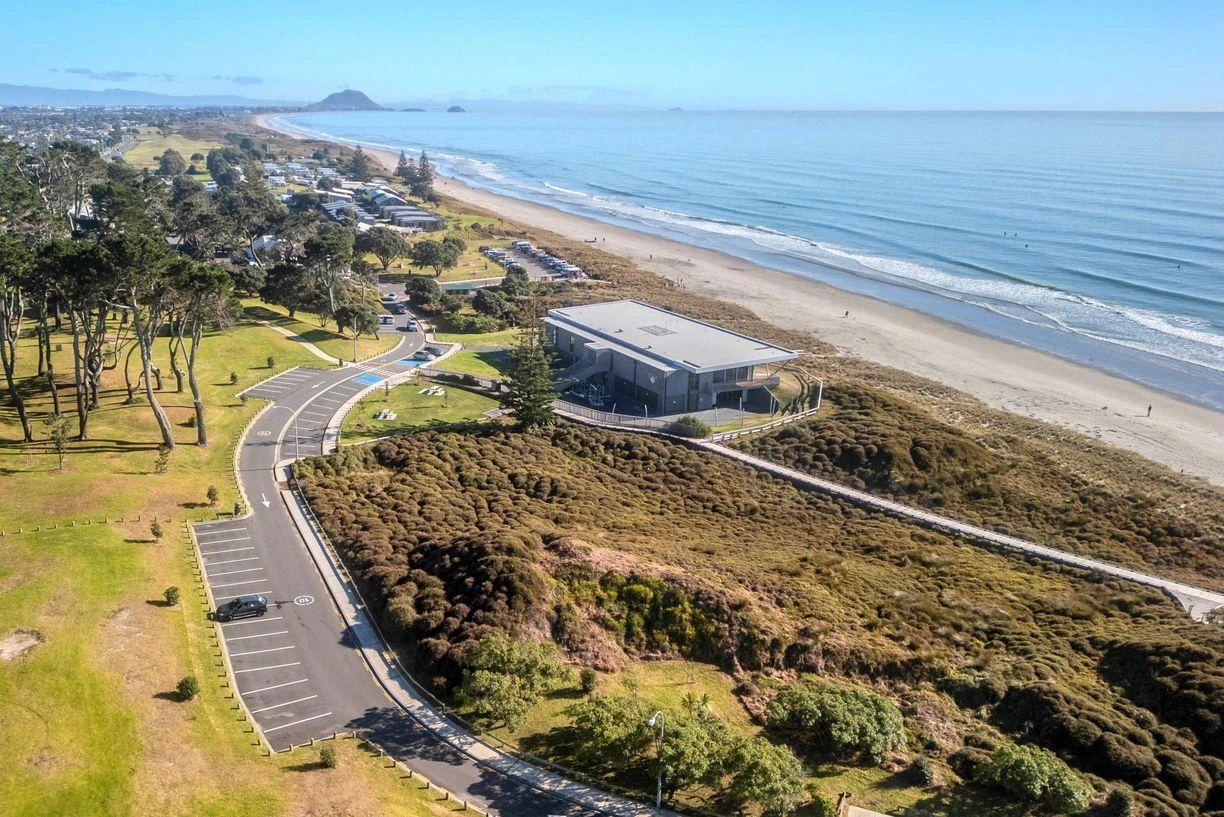
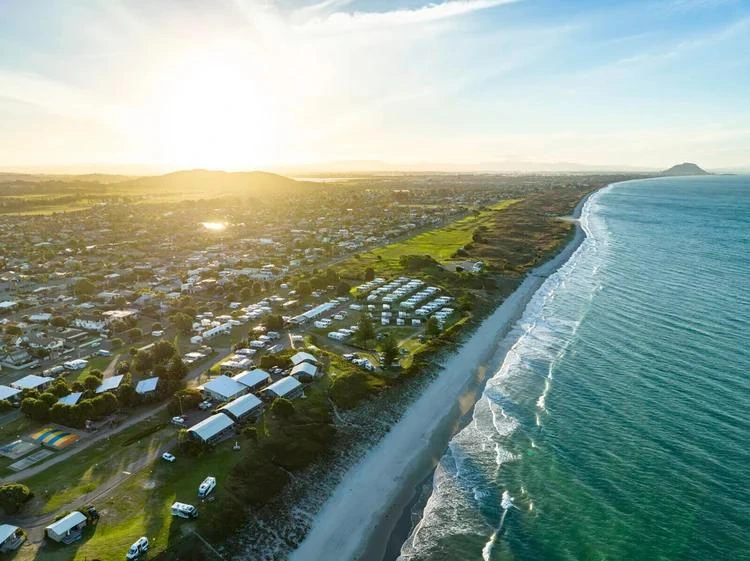
A Coastline in Transition
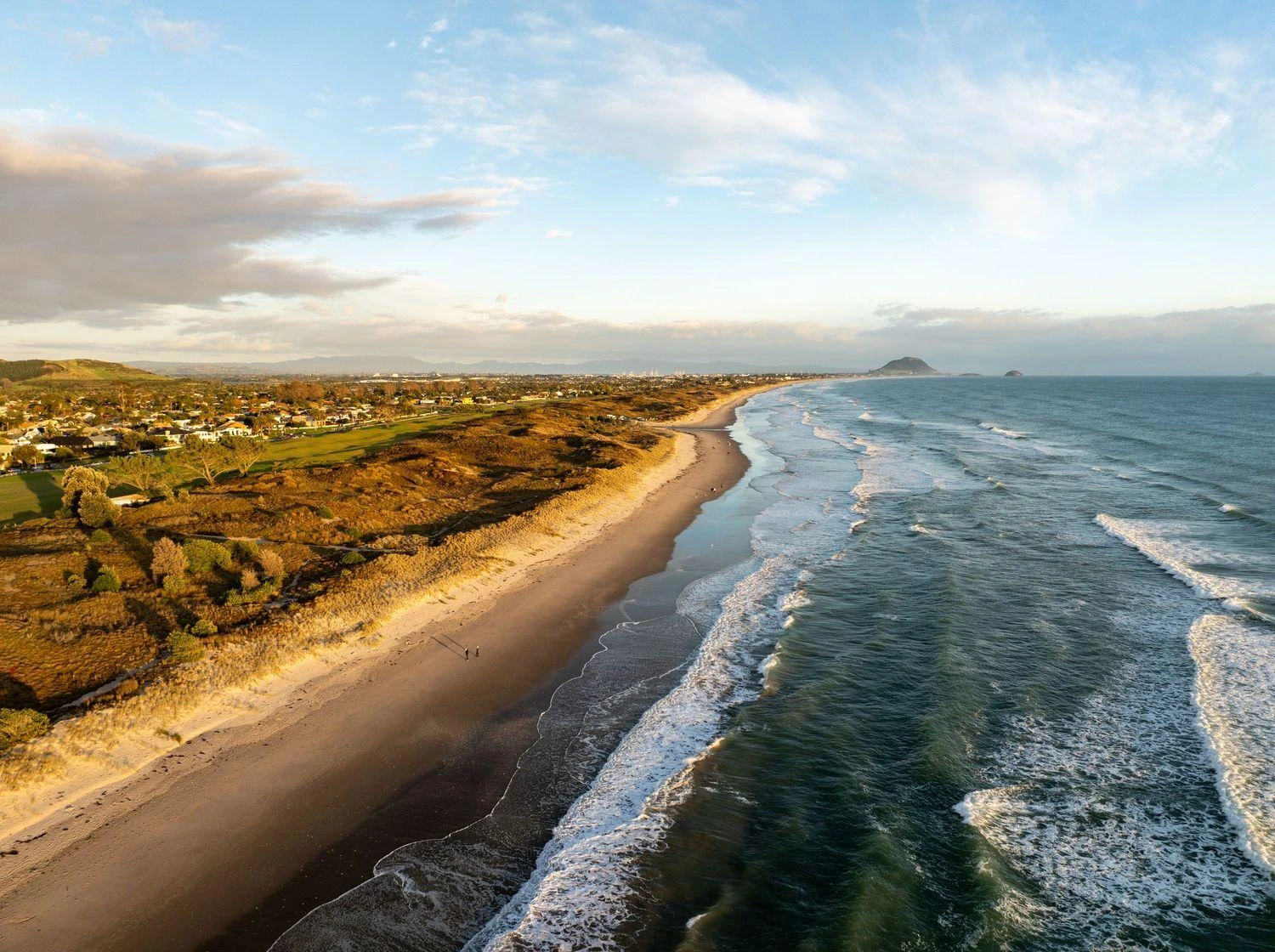
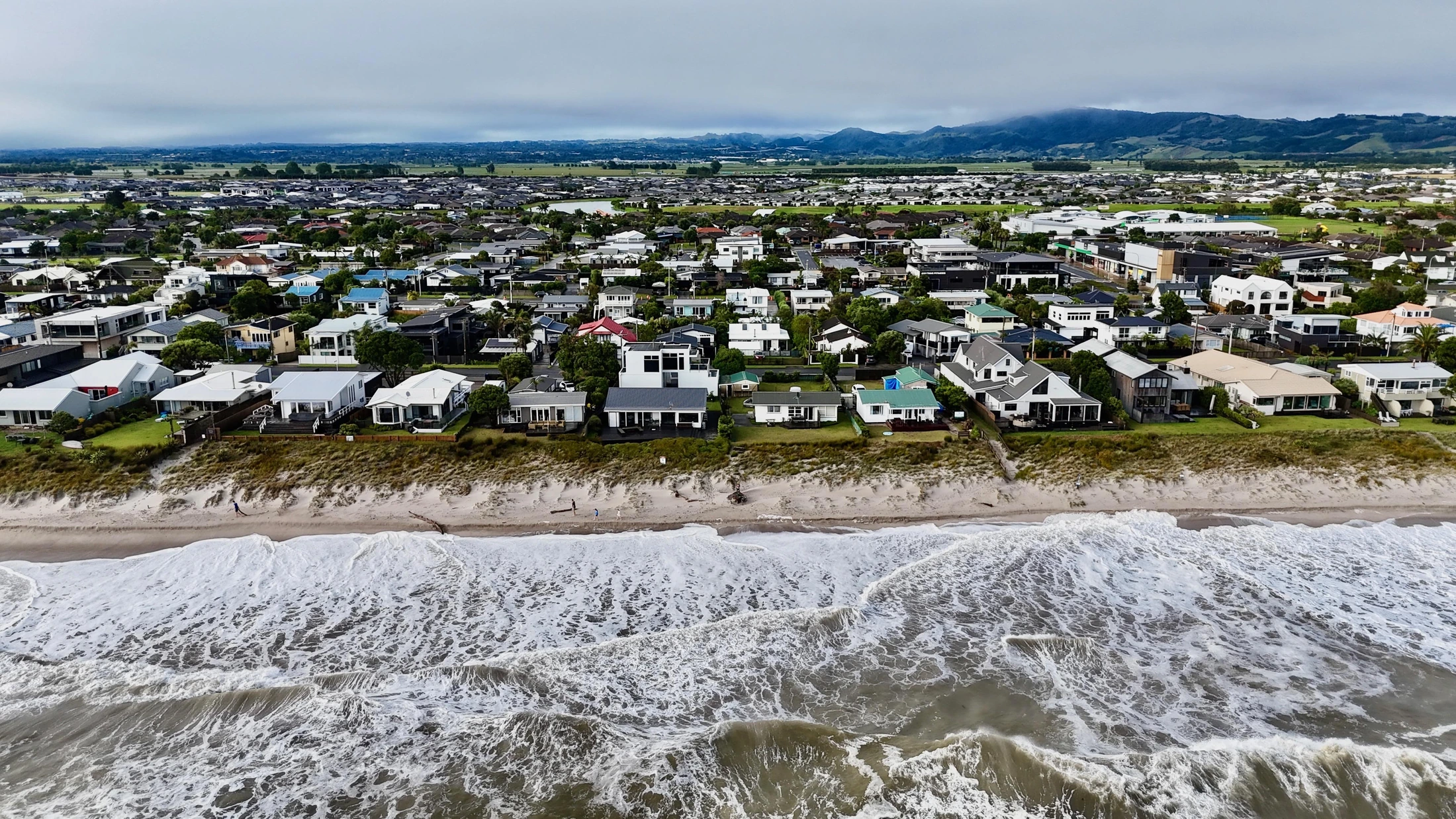
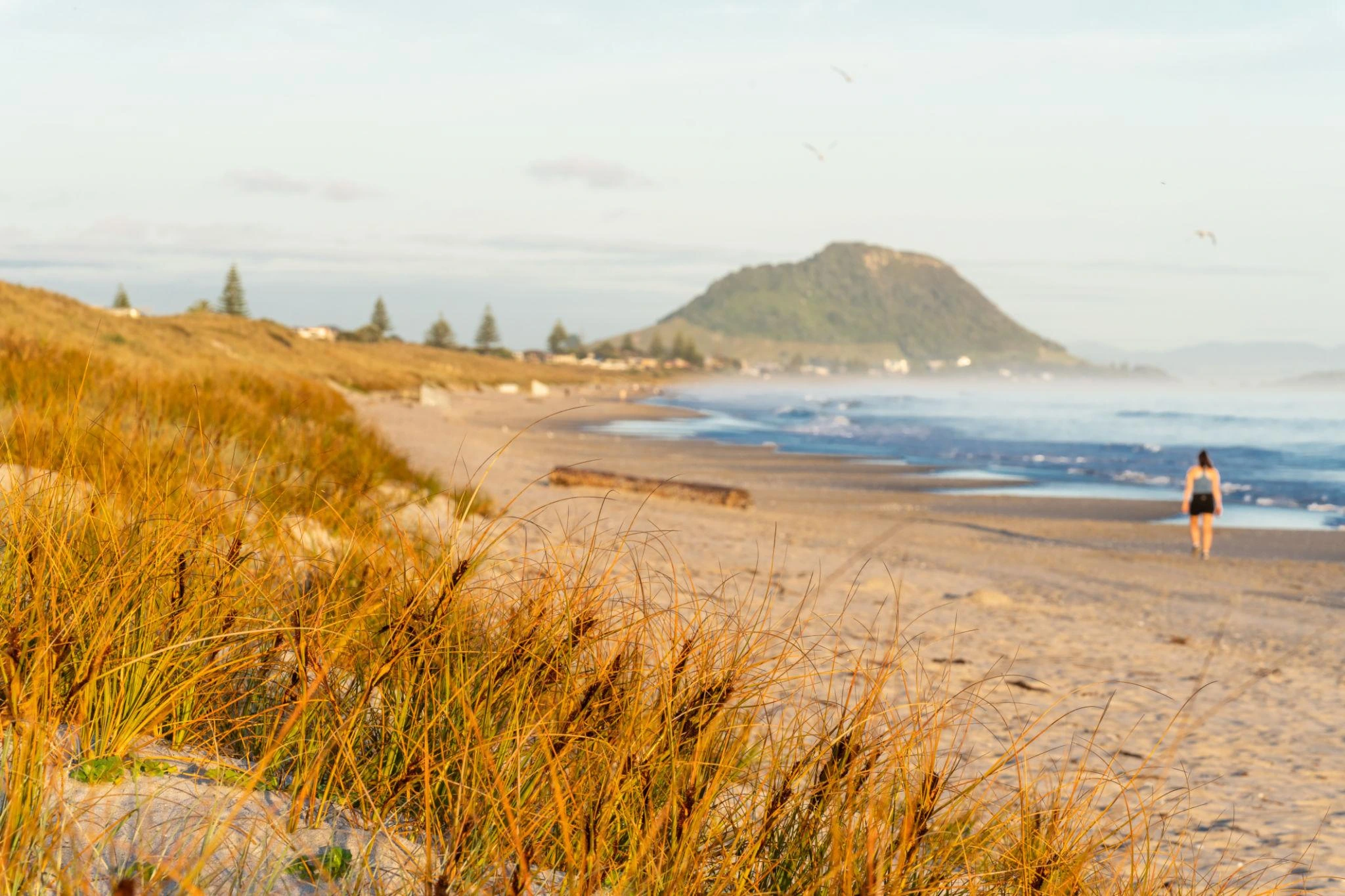
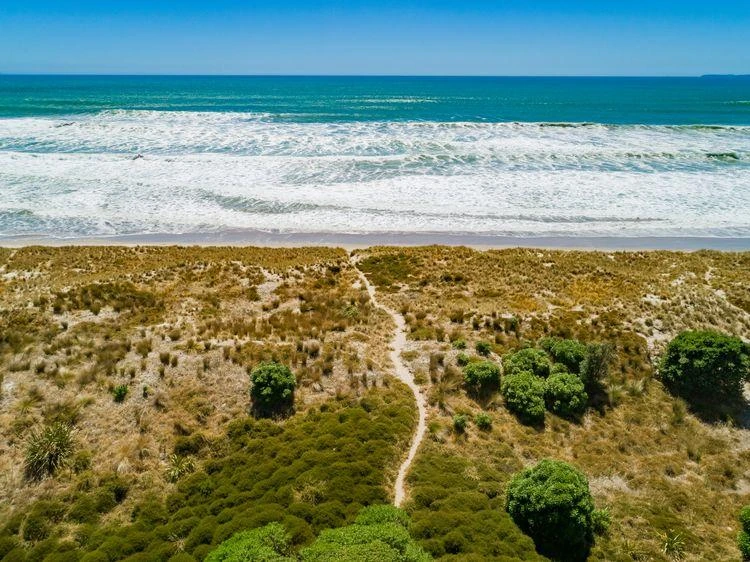
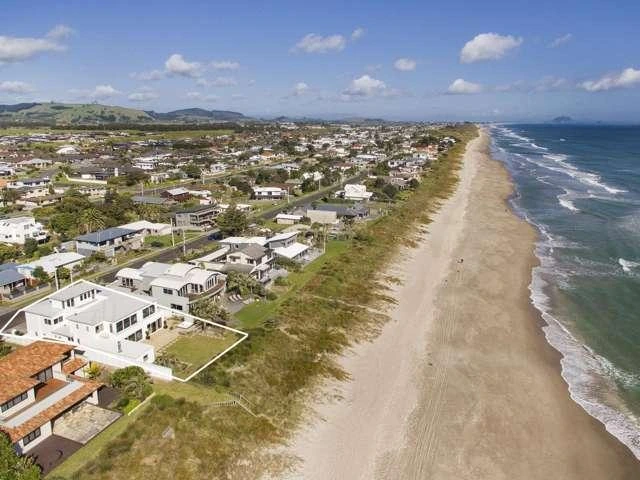
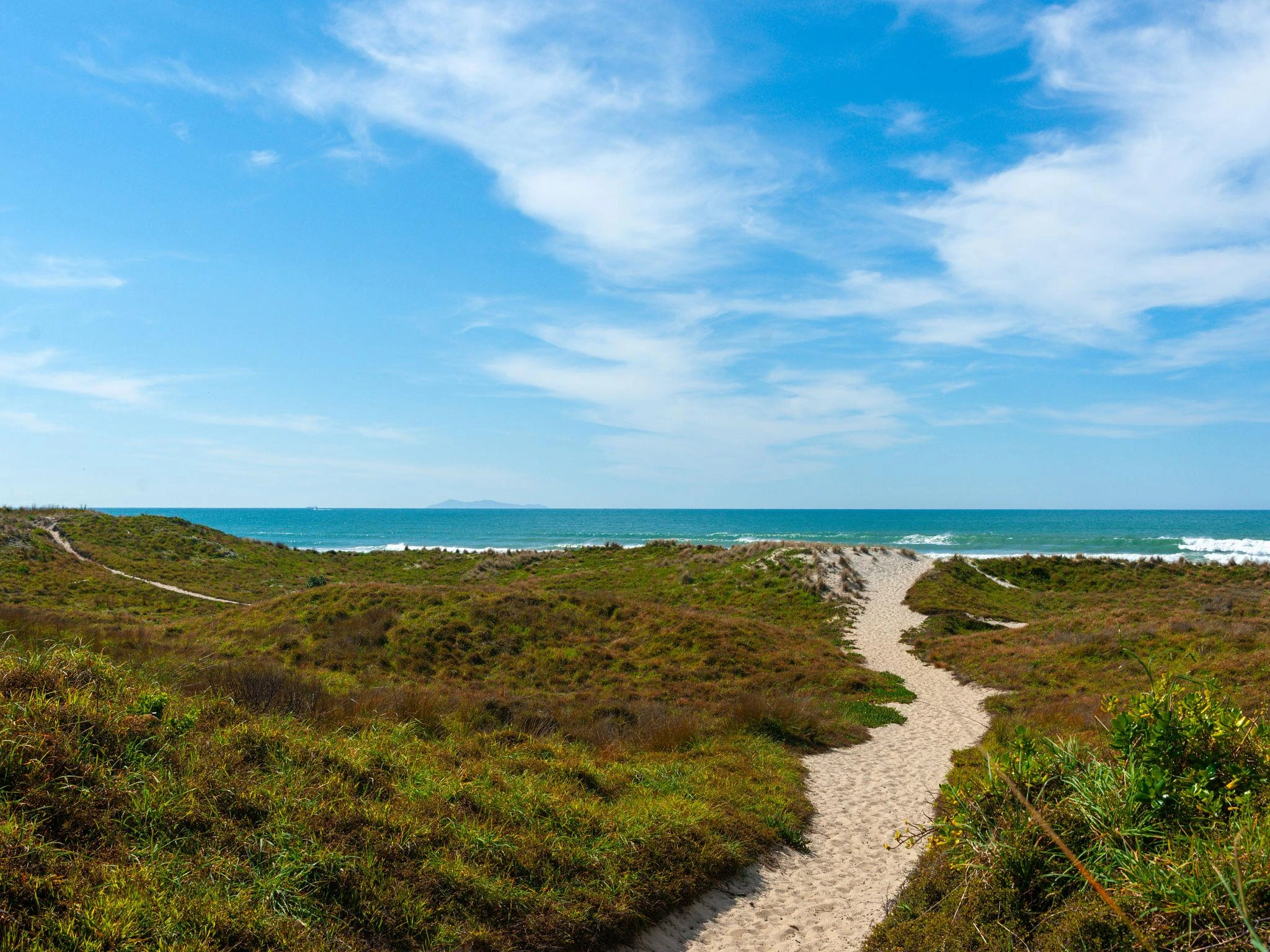
Along the Bay of Plenty's coastline, Pāpāmoa Beach stretches between the Pacific Ocean and a growing urban landscape. Its sandy beaches and vegetated dunes form a natural boundary between the sea and the communities that live behind them. But this boundary is anything but fixed. Sand shifts, dunes evolve and storms continually reshape the shoreline. Here, the relationship between a changing natural environment and a relatively permanent built landscape raises an important question:
How do we plan for a coast that never stands still?
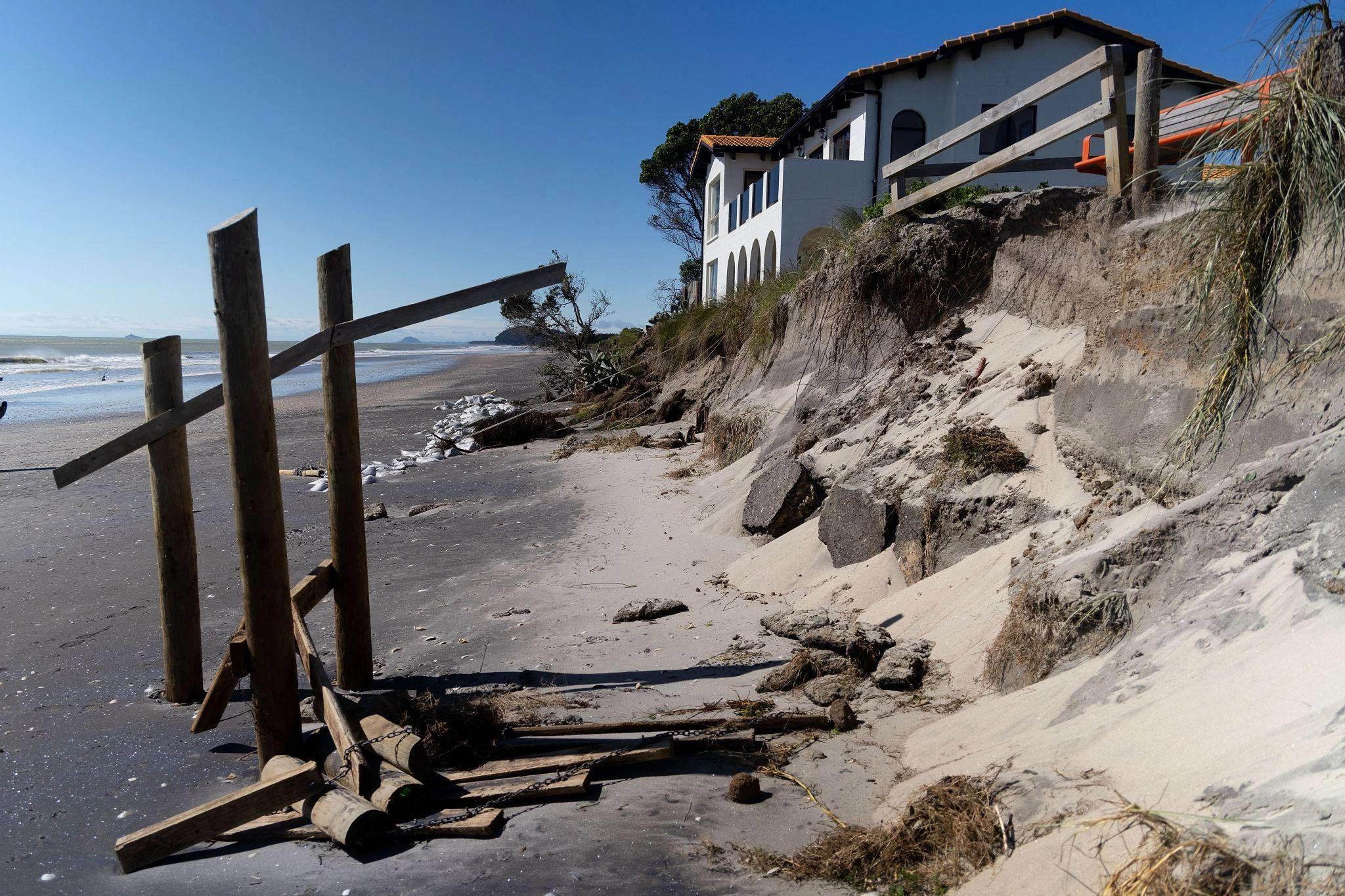
The natural process
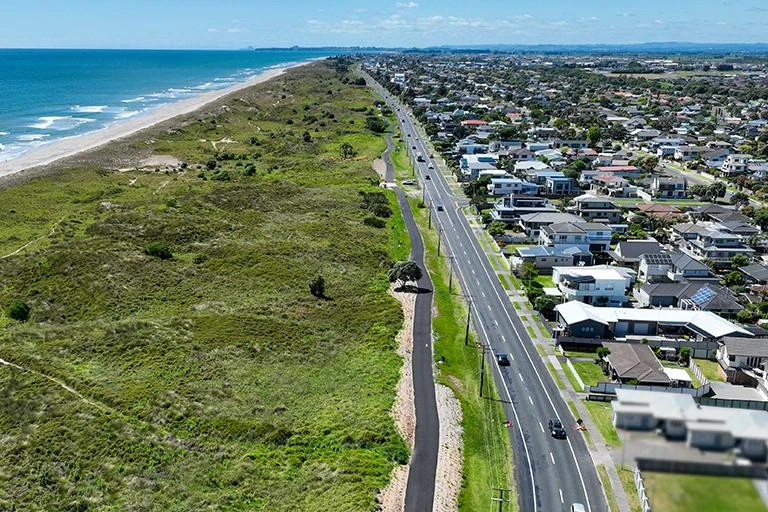
The human dimension
INTERACTIVE CROSS-SECTION
What changes when the water rises?
Move the controls to see the difference between a higher sea level and a temporary rise during a storm.
Raise the underlying water level: 0–2 m.
Add a temporary rise above that level: 0–2 m.
Start with the coastline
The water meets the beach. Increase either control to see the waterline move against a fixed land profile.
Illustration, not a Pāpāmoa hazard forecast. Heights use an arbitrary reference; the drawn dune crest is 3.2 m above it. This simplified model shows water connected to the sea against fixed terrain. It does not model waves, erosion, dune failure, drainage, or the time taken for flooding. The controls are not assigned to dates or probabilities.
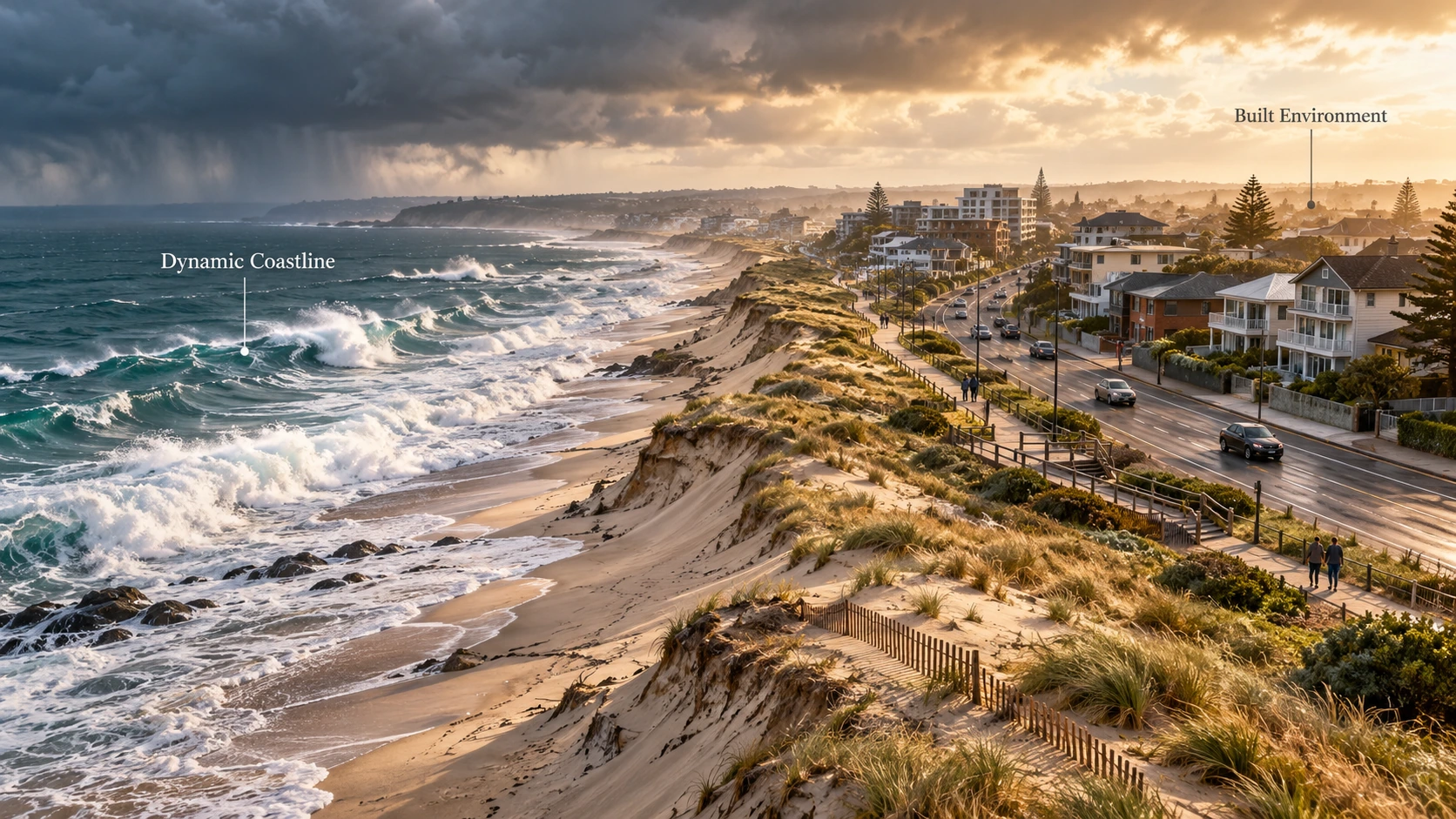
Simplified coastal cross-section showing the relationship between the ocean, beach, foredune, coastal road and residential development at Pāpāmoa Beach.
The Challenge:
When a Changing Coast Meets a Growing City
The coastline has always been shaped by natural forces. Waves transport sediment, storms reshape dunes, and the shoreline responds to changing sea levels. But when communities develop immediately behind these shifting coastal environments, natural processes become complex planning challenges. At Pāpāmoa Beach, the foredune system provides an important buffer between the ocean and residential development, roads and public infrastructure. Its ability to recover after storms plays a crucial role in maintaining that protection. As sea levels rise and coastal hazards intensify, the question becomes increasingly difficult: How long can existing management approaches remain effective, and What happens when they reach their limits?
Two Futures, One Coastline:
What if the Future Doesn't Follow the Plan?
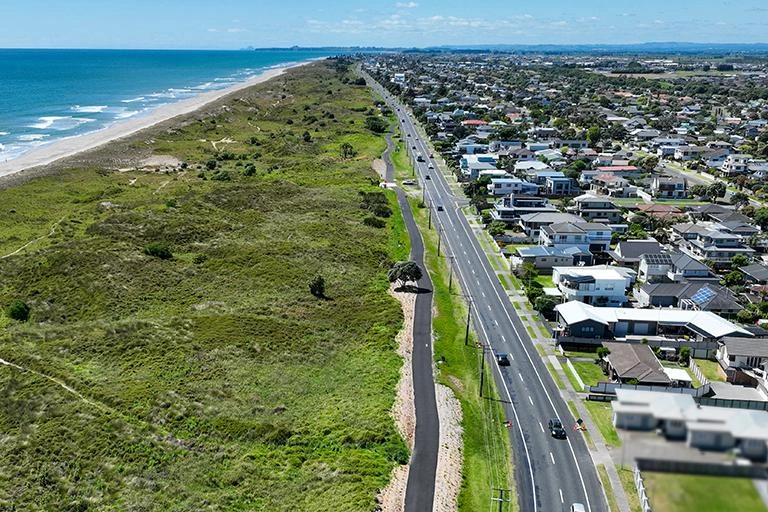
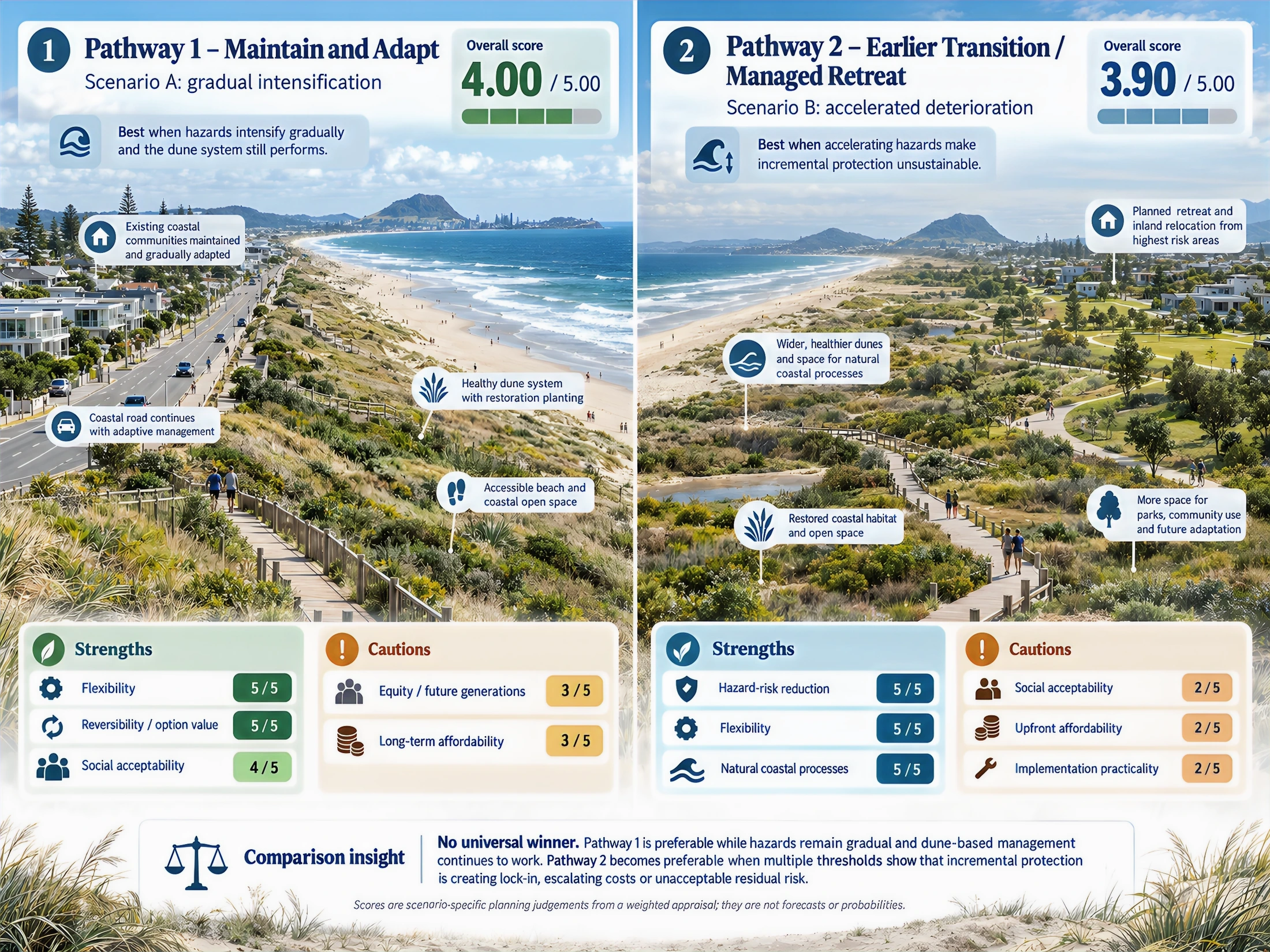
Scenario A - Gradual Intensification
Storm erosion and coastal water levels increase, but the foredune continues recovering after most events. Existing adaptation measures still have time to work.
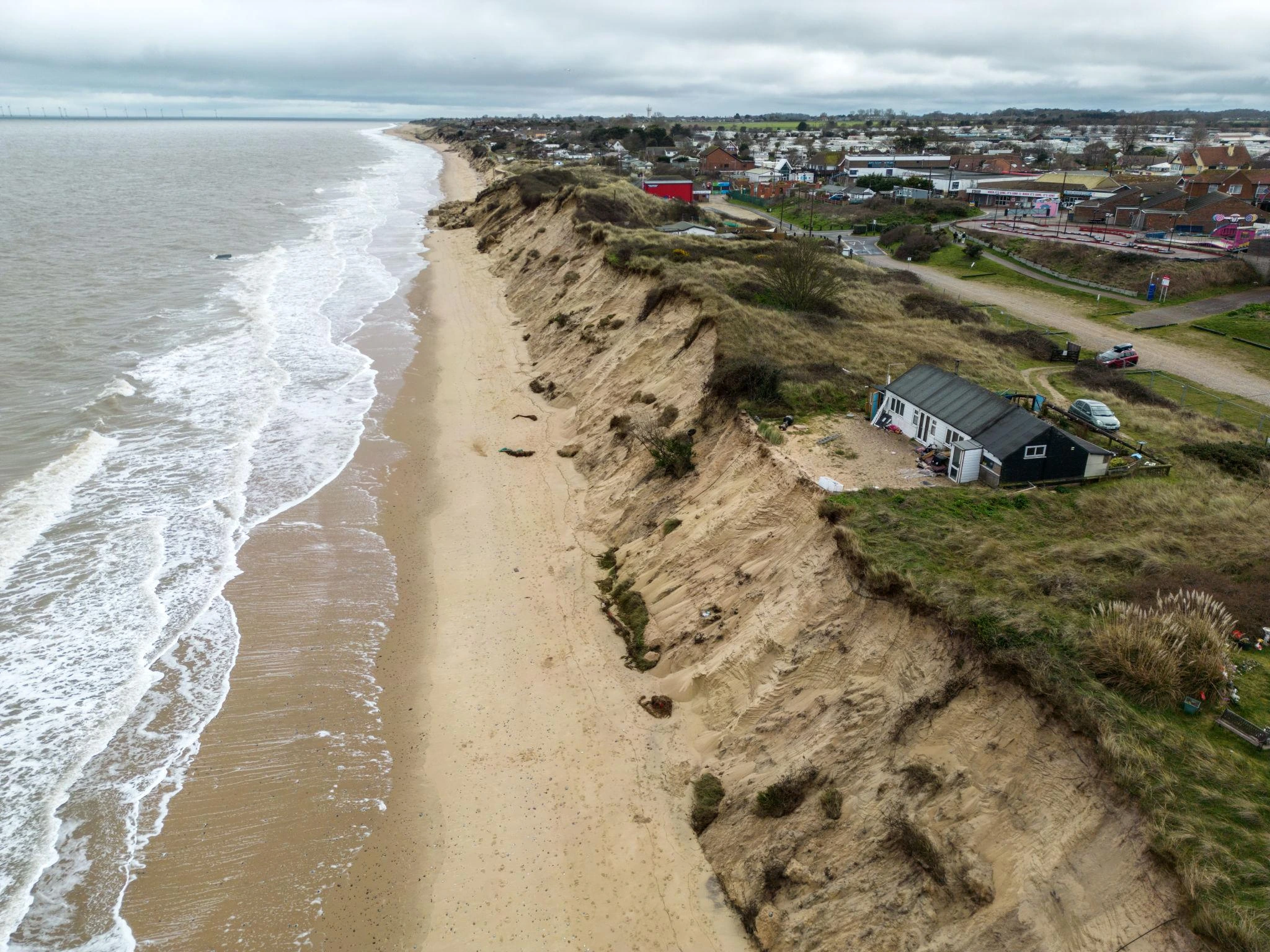
Scenario B - Accelerated Deterioration
Repeated storms weaken the dunes faster than anticipated. Coastal management becomes more expensive, and difficult decisions must be made earlier.
Imagine two possible futures for Pāpāmoa Beach. In one, the coastline changes gradually. Dunes continue to recover after storms, and existing management measures remain effective for longer. In another, erosion accelerates, dune recovery weakens, and the cost of maintaining protection increases. Both futures concern the same coastline, but they demand different responses. How can planners prepare for either possibility without knowing exactly which future will unfold?
Planning for a Future We Cannot Predict
What if we could prepare for both futures?
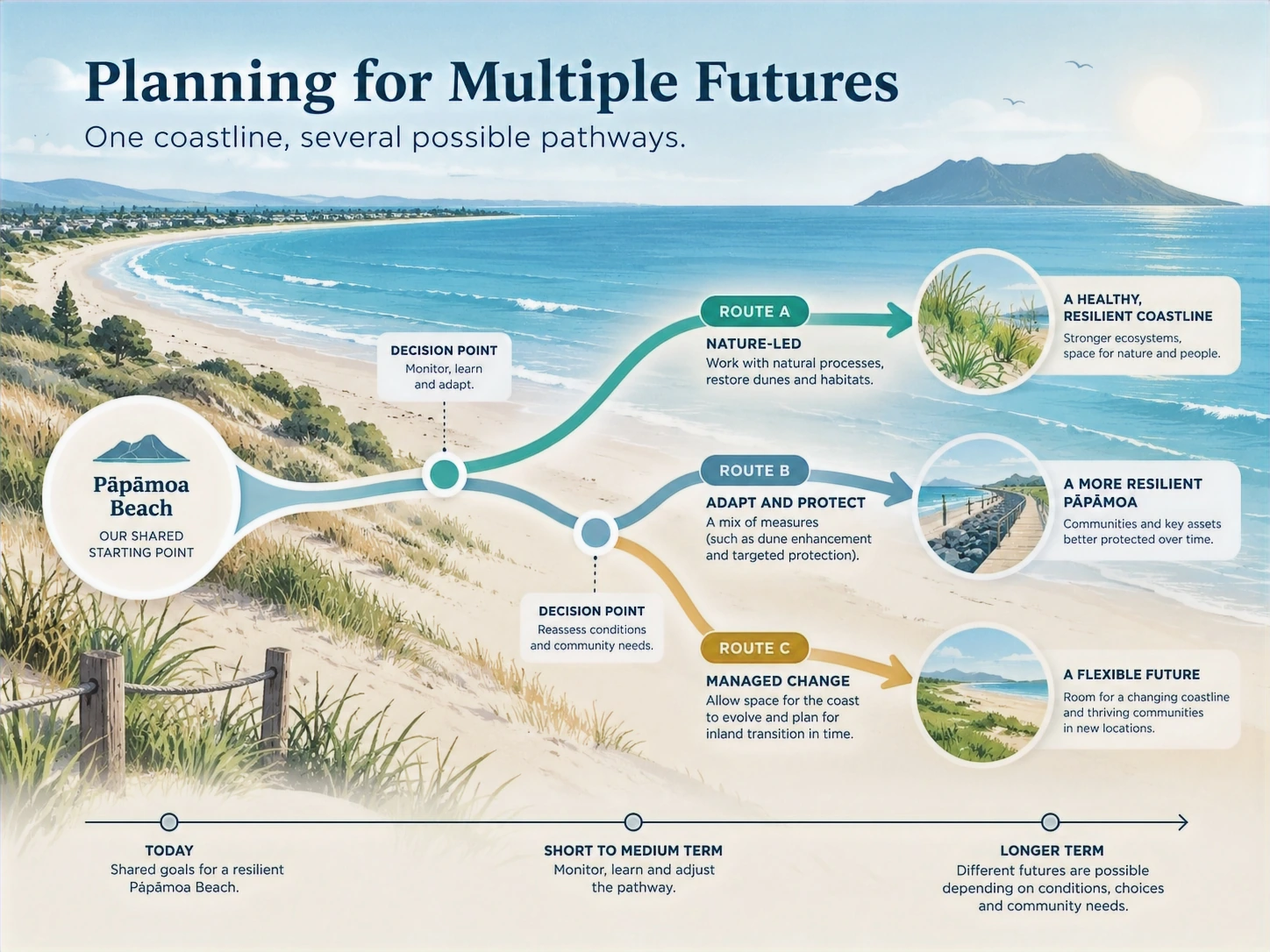
Imagine setting out on a journey without knowing what conditions lie ahead. You might choose a route, but what happens if that route becomes impassable? Would you continue regardless, or prepare alternative routes that allow you to change direction? Long-term coastal planning faces a similar challenge.
Dynamic Adaptive Policy Pathways (DAPP) offers a way to plan without assuming that the future will unfold exactly as expected. Instead of relying on one permanent solution, it prepares several possible courses of action and identifies the conditions under which a different approach may become necessary.
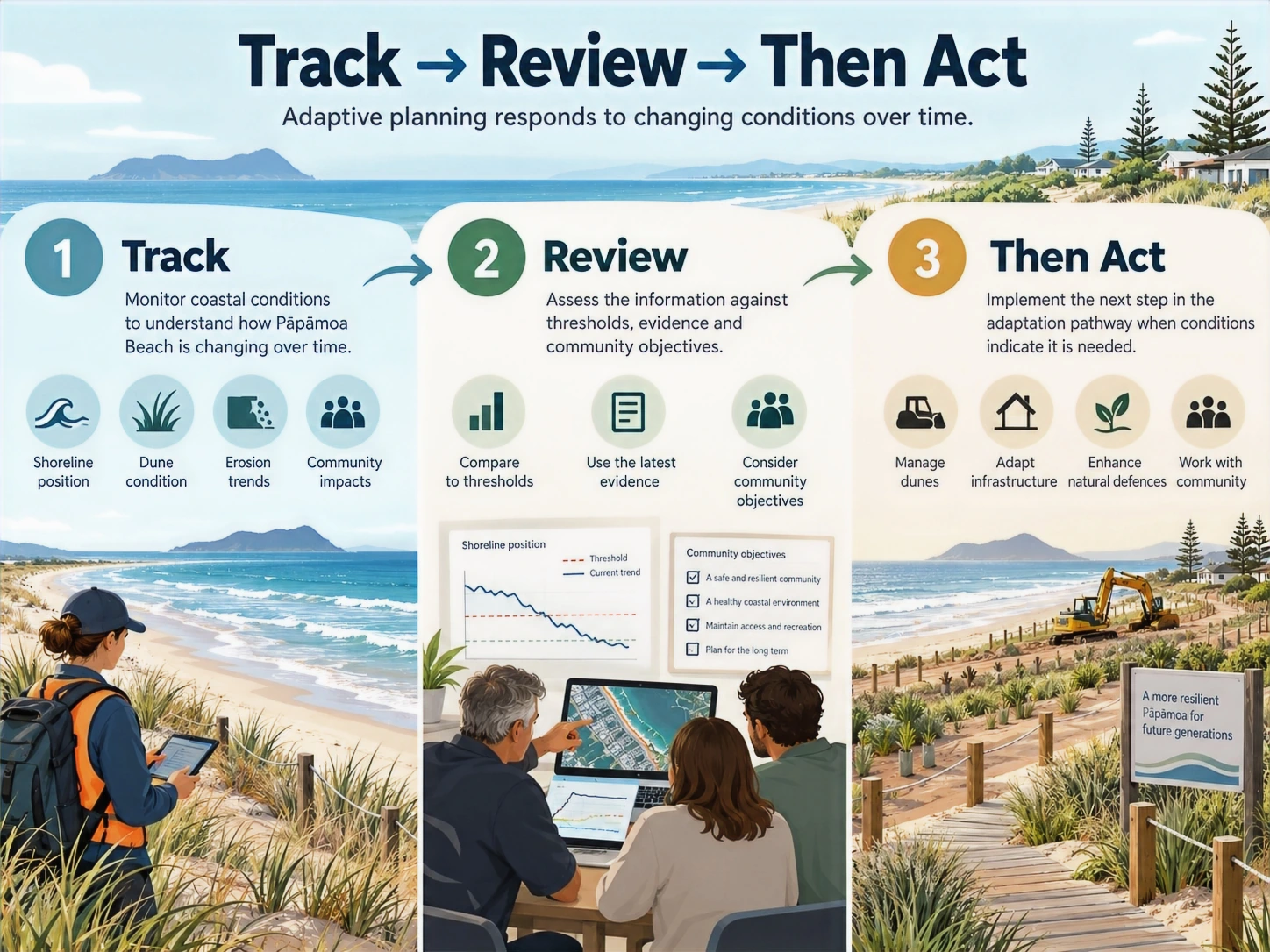
For Pāpāmoa Beach, the guiding principle is straightforward: Track → Review → Then Act.
The objective is not to predict precisely when change will happen, but to recognise when the current approach is reaching its limits and prepare for the next decision.
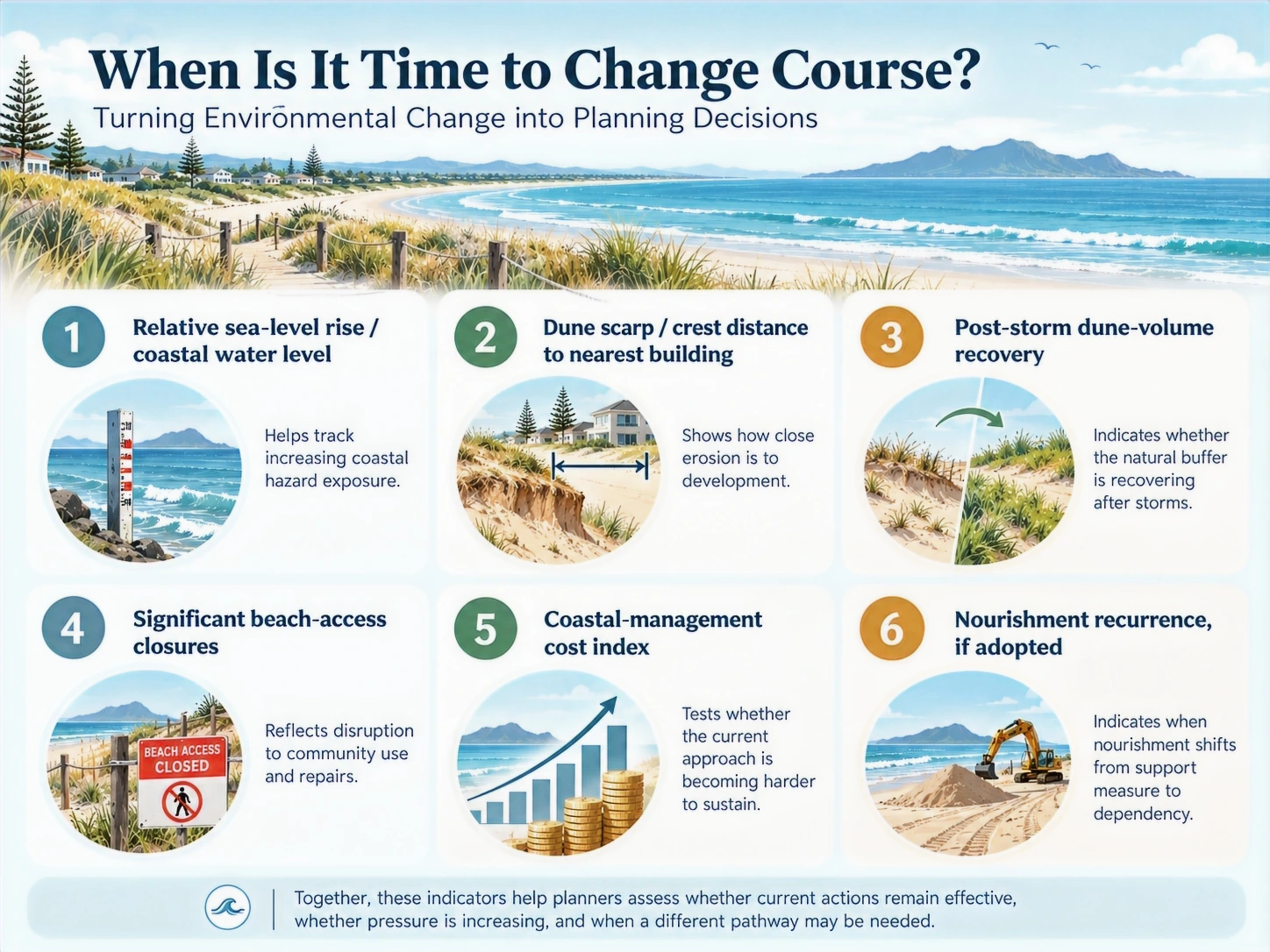
When Is It Time to Change Course?
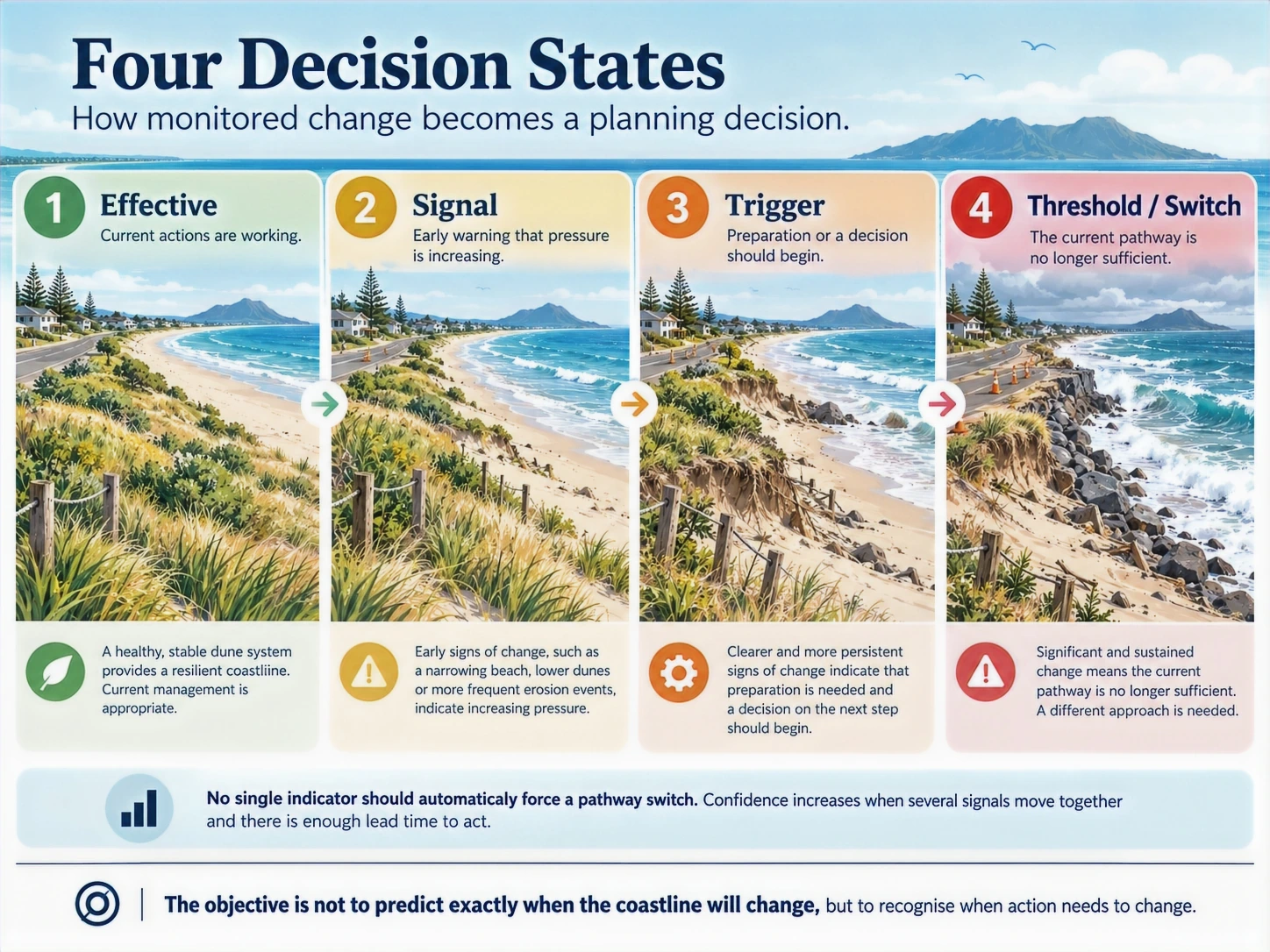
Coastal change rarely announces itself through a single event. A dune may gradually retreat, storms may leave behind more damage, or the cost of maintaining protective measures may steadily increase. How can these changes be translated into meaningful planning decisions? For Pāpāmoa Beach, I developed a monitoring framework using six indicators that capture both physical coastal processes and their consequences for the community. These indicators help answer three important questions: Is the current approach still effective? Are there signs that conditions are deteriorating? And when should preparations begin for a different adaptation pathway? The framework uses four colour-coded decision states, moving from effective conditions through early warning signals and action triggers to adaptation thresholds. Importantly, no single indicator automatically determines the future of the coastline. Decisions depend on how multiple indicators evolve together, the reliability of the evidence and the time needed to prepare an appropriate response.
Pathway 1 - Maintain and Adapt
Working with the coast before changing course
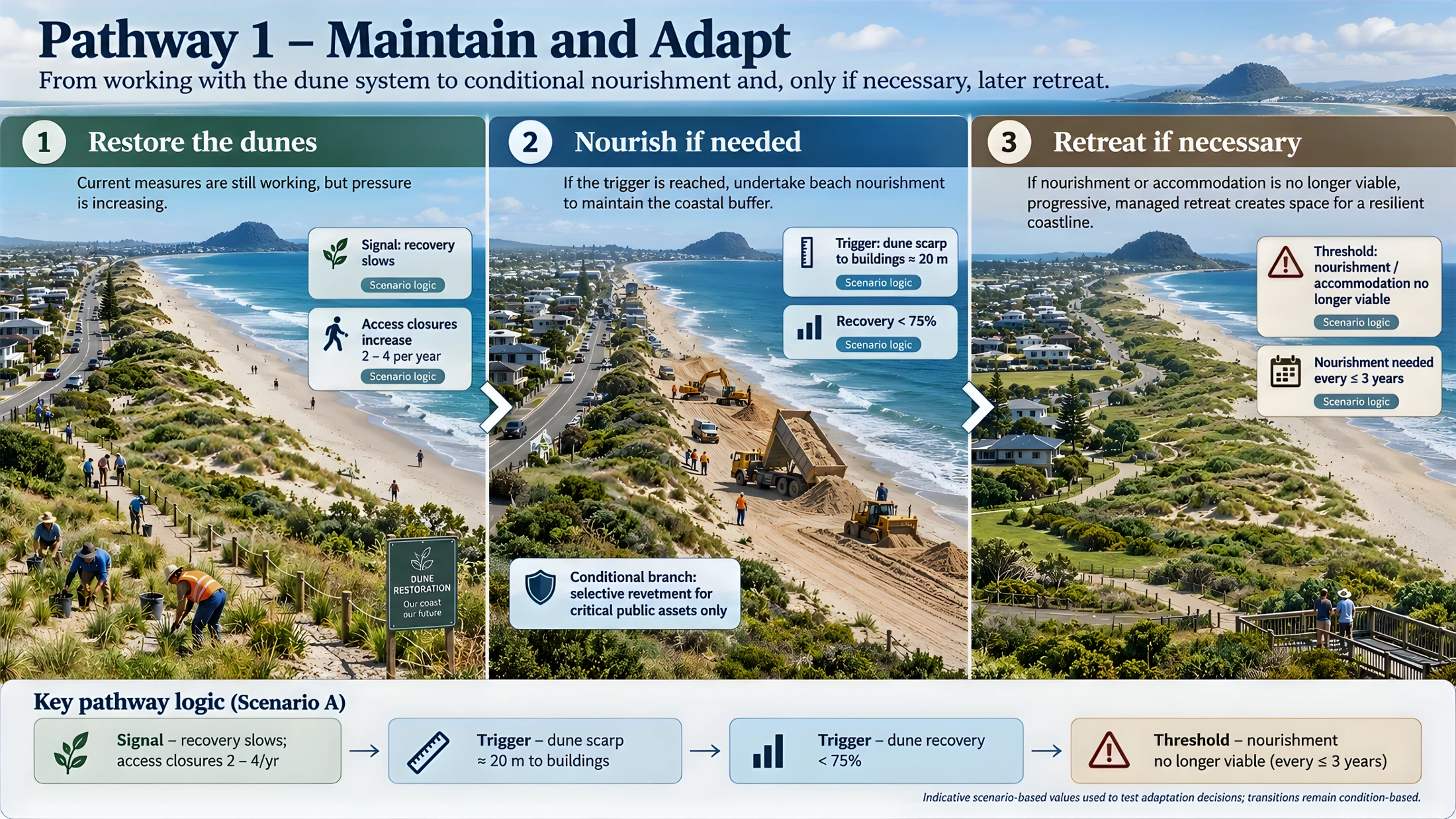
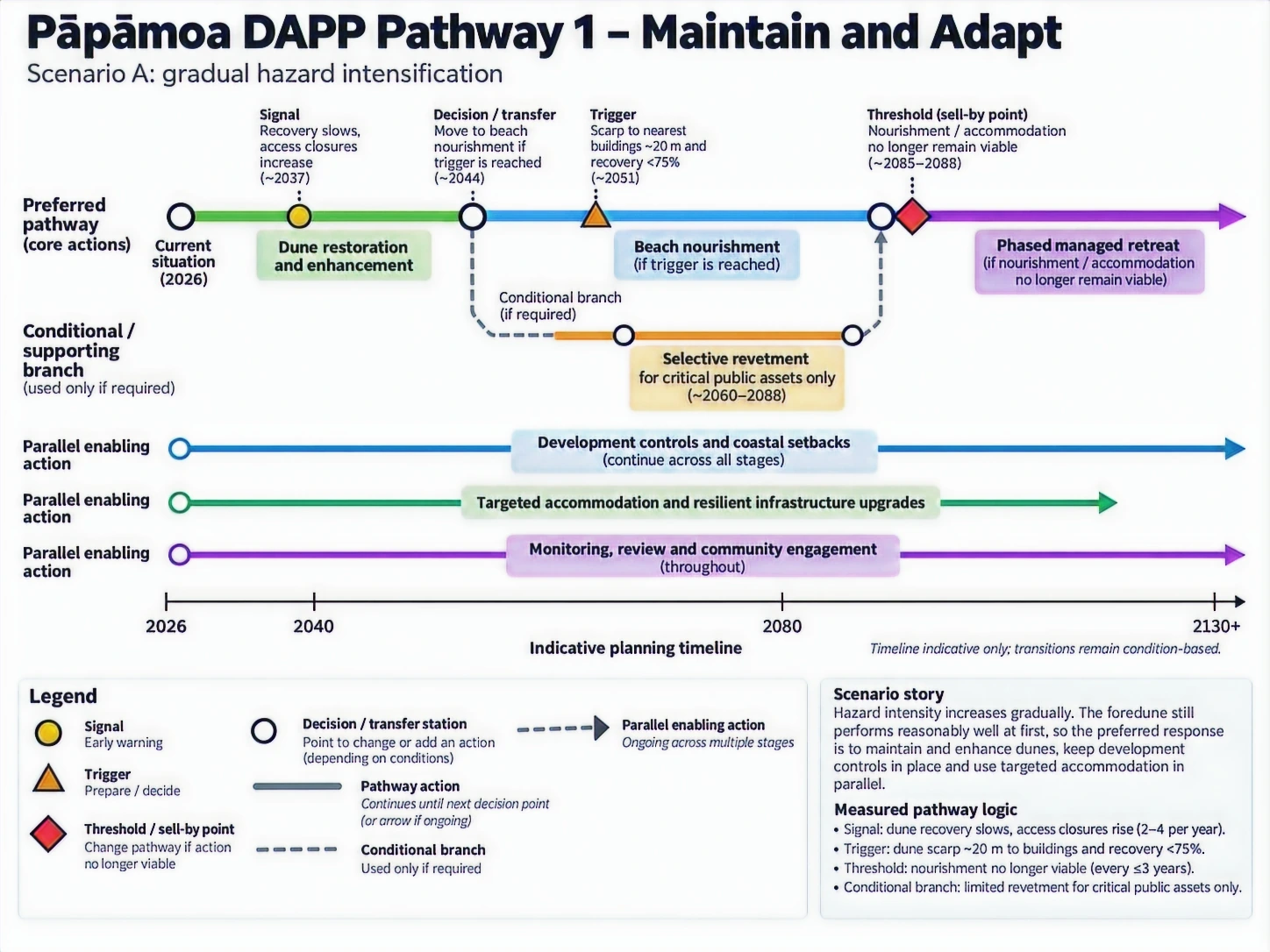
What happens when coastal hazards are increasing, but the natural dune system is still functioning? Under the gradual-intensification scenario, Pāpāmoa Beach may have time to adapt progressively rather than immediately pursuing major interventions. The pathway begins with dune restoration and enhancement, supported by development controls, targeted infrastructure adaptations and ongoing coastal monitoring. If erosion and other monitored conditions reach agreed triggers, beach nourishment may provide an additional period of protection, provided it remains environmentally and economically feasible. But nourishment is not assumed to work indefinitely. If the protective system eventually reaches its limits, the pathway provides for a transition toward phased managed retreat. The central idea is to maintain what works today while preserving the ability to change course tomorrow.
Pathway 2 - Earlier Transition and Managed Retreat
When protecting the coast is no longer enough
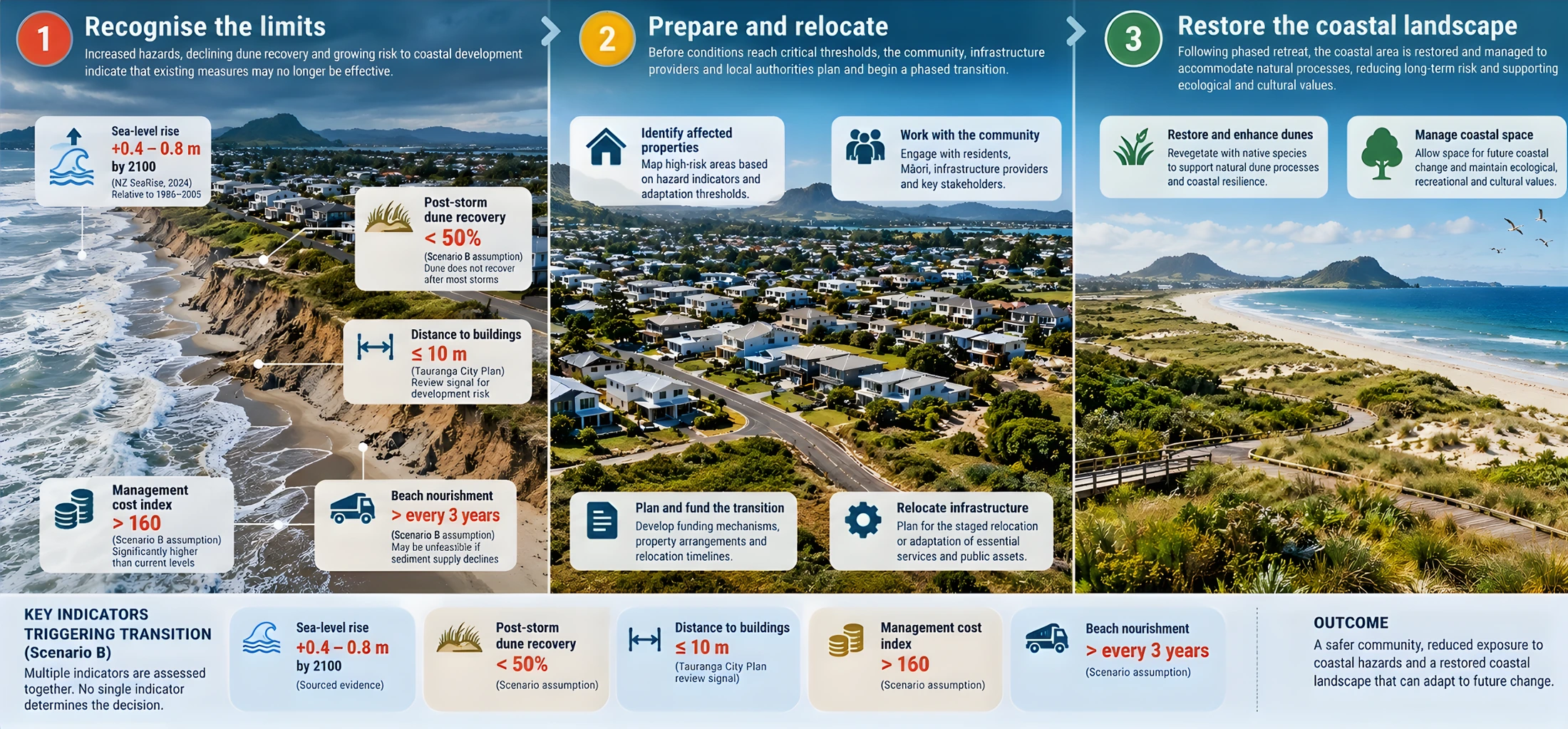
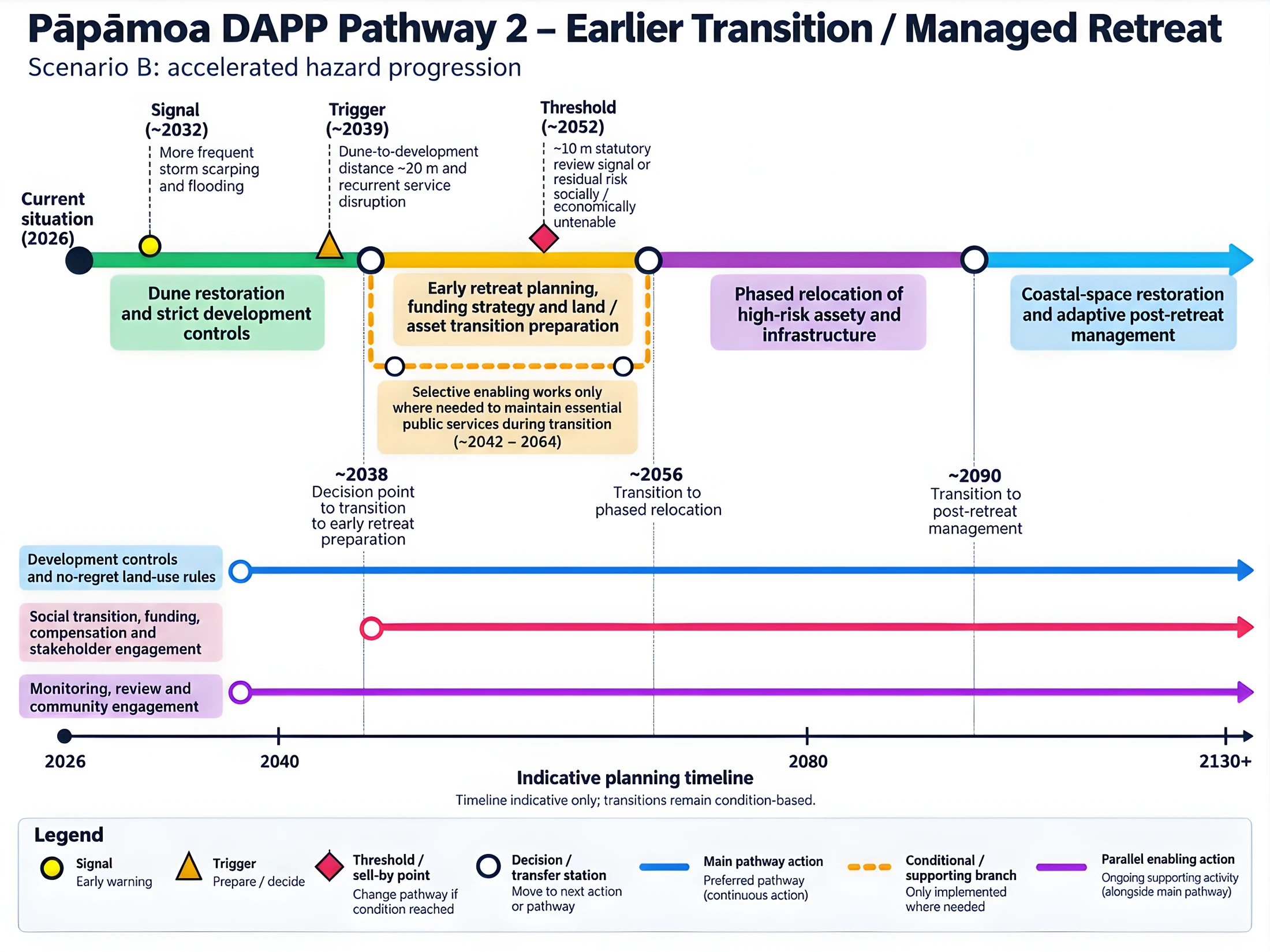
Imagine a future where storms arrive more frequently, the dunes struggle to recover, and the distance between the shoreline and nearby development continues to shrink. Under this scenario, maintaining existing coastal defences may become increasingly costly, difficult and ultimately unsustainable. Rather than waiting until coastal hazards force an emergency response, Pathway 2 introduces a more deliberate transition. Dune restoration continues in the short term, but planning for managed retreat begins earlier. This includes preparing relocation strategies, identifying funding mechanisms, supporting affected communities and making arrangements for essential infrastructure. As agreed adaptation thresholds are reached, the pathway moves toward phased relocation of high-risk assets and eventually the restoration of coastal space. The objective is not simply to retreat from the coastline, but to create the conditions for a safer, fairer and more planned transition.
Comparing the Two Pathways
Two Different Futures. Two Different Strategies.
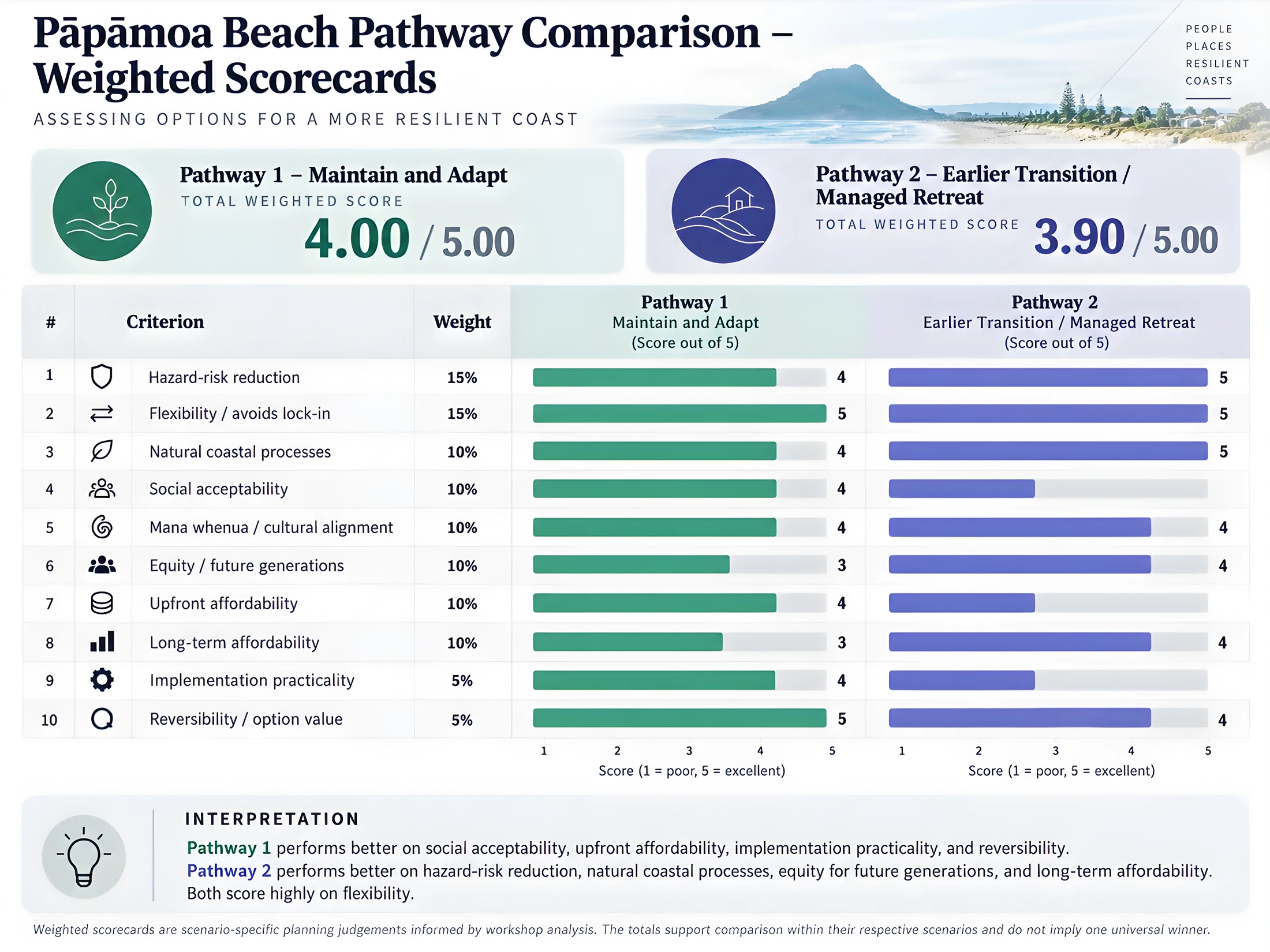
There is no single perfect solution to coastal adaptation. An approach that works well when environmental change is gradual may become ineffective, expensive or even harmful when hazards intensify more rapidly. To evaluate the two pathways for Pāpāmoa Beach, I developed weighted assessment scorecards covering ten planning criteria, including hazard-risk reduction, flexibility, environmental outcomes, social acceptability, cultural considerations, equity and affordability. The evaluation reveals an important trade-off. Maintaining and adapting the existing dune system can reduce immediate disruption and preserve future choices. Earlier managed retreat can provide stronger long-term risk reduction under accelerated deterioration, but introduces substantial financial, social and implementation challenges. The purpose of the assessment is not to identify one universal winner. It is to understand which strategy remains appropriate under different future conditions.